Free Narrow CPR Stock Scanner: Daily Shortlist for Breakout Trades
Narrow CPR · Stock Scanner
There are no items in your cart
Add More
Add More
| Item Details | Price | ||
|---|---|---|---|
"What Really Matters for Narrow CPR Trading" By Trading Direction | CPR Series | June 2026
Fri Jun 5, 2026
"Narrow CPR day is my favorite day for breakout trading — Anil Hanegave
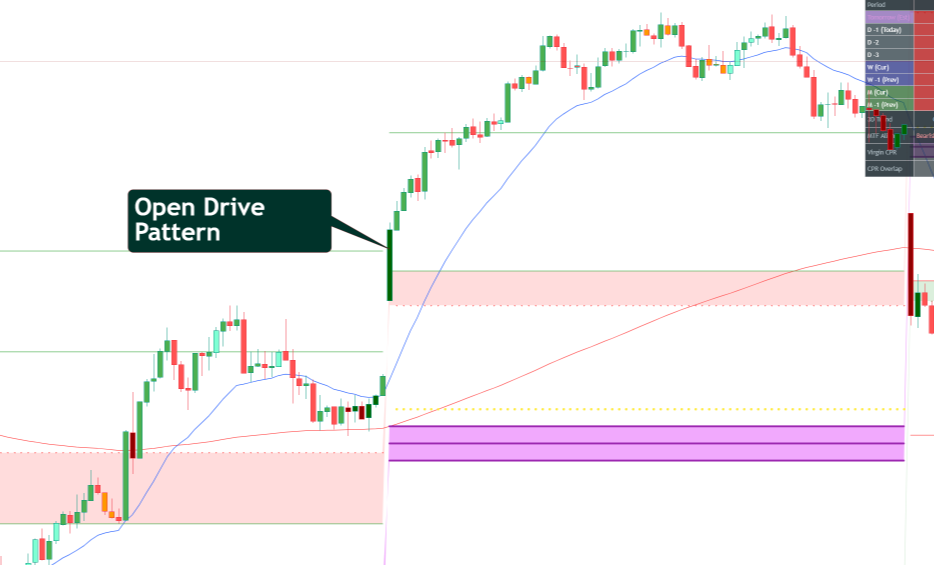
Narrow CPR.
The logic is simple.
When the Central Pivot Range becomes extremely tight, the market is compressing energy. Like a spring being squeezed, the tighter the compression, the stronger the potential move once price breaks out.
Yet many traders complain:
"I found a Narrow CPR setup, but it never gave a trend day."
The problem may not be the CPR.
The problem may be how your screener defines "Narrow."
The Central Pivot Range (CPR) consists of three important levels:
PP (Pivot Point) = (H + L + C) / 3
BC (Bottom Central) = (H + L) / 2
TC (Top Central) = PP + (PP − BC)
CPR Width % = |TC − BC| / PP × 100
The smaller the distance between TC and BC, the tighter the CPR.
A tight CPR indicates market compression and the potential for a powerful directional move.
in opposite, Wide CPR When the CPR band is broad, the market often remains range-bound and price tends to oscillate within defined levels rather than trend aggressively.
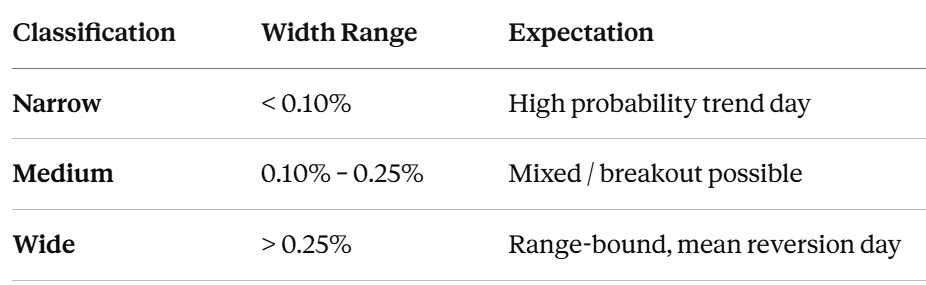
Many professional CPR traders use fixed percentage ranges:
Narrow CPR: Width < 0.25%
Medium CPR: Width between 0.25% and 0.50%
Wide CPR: Width > 0.50%
Simple.
Consistent.
Easy to compare across different market conditions.
On 6th March 2026, the Daily CPR Width on NIFTY was approximately:
This was one of the tightest CPR readings seen in recent weeks.
For experienced CPR traders, a 0.09% CPR immediately signals:
✅ Potential Trend Day
✅ High-Conviction Breakout Setup
✅ Increased Probability of Expansion
However, the CPR By Trading Direction V6 indicator classified this CPR as:
The exact opposite interpretation.
Why?
Because the Adaptive Threshold feature compared today's CPR against recent historical widths.
The calculated Medium ceiling was approximately 0.094%.
Since 0.09% fell marginally outside the adaptive definition, the setup was incorrectly pushed into the "Wide" category.
The result?
A genuinely compressed CPR structure was no longer recognized as a breakout candidate.
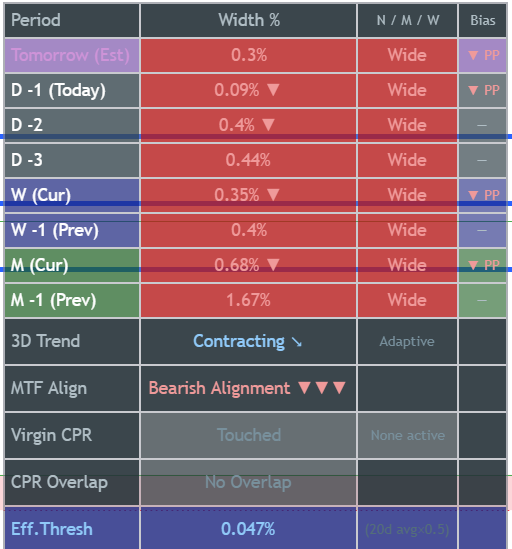
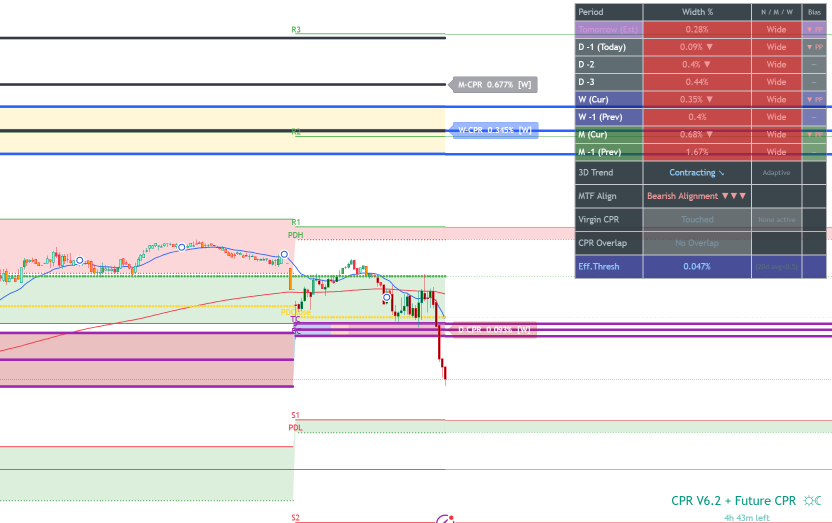
The market did not produce an aggressive bullish breakout.
However, it eventually delivered a downside breakdown after prolonged consolidation.
This is an important lesson.
A Narrow CPR does not predict direction.
It predicts compression.
Direction comes from structure, context, and alignment.
The tight CPR correctly identified stored energy.
The market simply chose to release that energy on the downside.
Why "Narrow Is Narrow"This is where many traders misunderstand CPR theory.The foundation of CPR is based on an absolute concept:Compression is Compression.A CPR width of 0.09% is objectively narrow.It does not become wide simply because recent market conditions were also narrow.Price does not care about averages.Price reacts to compression.The tighter the range, the greater the possibility of expansion.That principle remains unchanged whether the last 20 days were volatile or quiet.
For Beginners:
They are easy to understand.
They create consistency.
They help traders build pattern recognition.
For Professional Traders:
Adaptive measurements help identify unusually compressed conditions relative to recent market behavior.
However, adaptive filters should never replace the fundamental CPR concept.
They should complement it.
Not redefine it.
The 6 March 2026 Lesson
The CPR width was extremely narrow. Energy was clearly building. The market remained below major pivot structures. Weekly, Monthly and Daily bias pointed lower. The correct approach was not predicting direction. The correct approach was: Trade the Breakdown Below BC. Eventually, that is exactly what the market delivered.
Final ThoughtsA Narrow CPR is not a buy signal. A Narrow CPR is not a sell signal. A Narrow CPR is a warning that volatility is likely to expand. The real edge comes from combining: ✔ CPR Width
✔ Virgin CPR
✔ Multi-Timeframe Alignment
✔ Trend Structure
✔ Breakout Confirmation Trade the structure. Trust the levels. Keep the rules consistent. The market rewards discipline, not guess.
About the Indicator CPR V6.2 + Future CPR Indicator by Trading DirectionAvailable on TradingView.

Mr. Anil Hanegave
Coach and Author of 8 Books.