In this article — you'll learn what the 9.20 strategy is, see a real trade case study with chart observations, understand the exact CPR-based rules that keep you out of losing trades, and watch a real example of the setup failing when the Weekly-Daily Pivot (WDP) doesn't align.
What Is the 9.20 Strategy?
The 9.20 strategy is a time-based intraday trading technique that waits for the first 20 minutes of the market session (9:15–9:20 AM IST) to pass before entering a trade. This brief window allows early volatility to settle and a clear directional bias to emerge — backed by CPR (Central Pivot Range) levels.
By combining CPR structure with the first 5-minute candle's behavior, traders can identify high-probability setups with well-defined risk, making it one of the most popular strategies taught at
Trading Direction.
Case Study: A Real 9.20 Trade
Here's a step-by-step walkthrough of a live trade executed using this strategy:
1
Market Setup (CPR Analysis)
The weekly CPR was positioned below price, while the daily CPR sat above. This stacked structure signaled a bullish bias — the market had upside room toward the daily CPR resistance.
2
Entry Confirmation
The first 5-minute candle formed cleanly inside the defined trading zone (not the trap zone), confirming the bullish setup. Entry was taken at the close of this candle.
3
Profit Booking at R1
As price approached R1 (Resistance 1) on the pivot levels, profit was booked. The trade lasted just a few minutes, locking in gains quickly and cleanly.
Key Observations from the Chart
1. Options Trading Above CPR on 2-Minute Chart
On the 2-minute timeframe, the options contract traded consistently above the CPR. This is a strong confirmation signal — it tells the trader that buying pressure is dominant and the bullish trend has structural support.
2. Order Book & Timed Entries
Monitoring the order book revealed staggered buy orders building up near the CPR level. This allowed for a precise, low-risk entry and a staged exit as price moved toward target.
3. Avoid the Trap Zone
⚠️ Trap Zone Warning: When price is trading inside the CPR range (between BC and TC), the market is in a "trap zone." Do not take directional trades here — wait for a confirmed breakout above or below before entering.
🔑 Simple Rule: Only trade the 9.20 strategy when the first 5-minute candle forms clearly above or below the CPR zone — never inside it. That single filter eliminates most false signals.
When the 9.20 Strategy Fails: A Real Stop-Loss Case Study
The 9.20 strategy is not a mechanical, win-every-time system — and it's worth showing you exactly where it breaks down. The setup above worked because the weekly CPR and daily CPR were stacked correctly. Most losing 9.20 trades happen for the opposite reason: the Weekly-Daily Pivot (WDP) doesn't align.
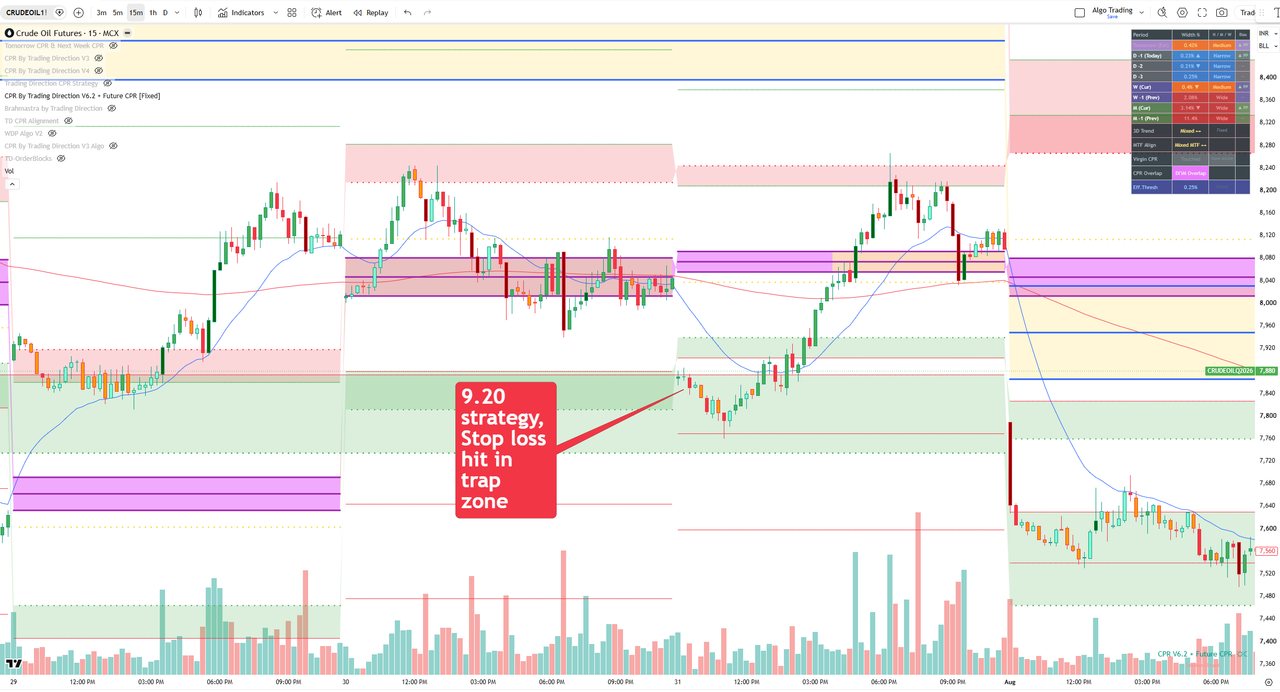
In Crude Oil futures on MCX, a trade was taken after price appeared to break out of the trap zone on the 15-minute chart. On the surface it looked like a valid 9.20-style entry. But the weekly and daily pivot structure were not properly aligned that session — price re-entered the trap zone shortly after, and the stop-loss was hit.
Crude Oil Futures (MCX), 15-min chart — stop-loss hit after price fell back into the trap zone. WDP was not aligned for this session.
⚠️ Why it failed: A breakout out of the trap zone only holds up reliably when the weekly and daily CPR/pivot are aligned in the same direction. When they're not aligned — one giving a bullish read, the other giving a mixed or opposing read — a move out of the trap zone is far more likely to be a fake-out that snaps back and takes out your stop-loss before the real move (if any) develops.
Watch: Anil Sir Breaks Down This Exact Trade
In this video, Anil Sir walks through this live observation on the chart — why the setup looked valid on the surface, why the WDP mismatch was the real problem, and how he reads this failure pattern in real time.
🎥 Anil Sir's live trading observation — what happens when WDP doesn't match for the 9.20 strategy
🔑 Updated Rule: Before taking a 9.20 trade, check that the weekly pivot and daily pivot are telling the same story. A clean 5-minute candle outside the trap zone is not enough on its own — confirm WDP alignment first, or treat the trade as lower-probability and size down accordingly.
Why CPR Levels Are the Foundation
The Central Pivot Range (CPR) is calculated from the previous session's high, low, and close. It creates three levels — Top Central (TC), Central Pivot (CP), and Bottom Central (BC) — that act as dynamic support and resistance.
When the daily CPR is narrow and price opens above it, the market tends to trend strongly. When the weekly and daily CPRs are stacked (one above, one below), they create a natural magnet for price — which is exactly the setup used in the 9.20 strategy.
To go deep on CPR-based trading with live examples and mentorship, visit the
Trading Direction course store and use coupon code ANALYSIS3 to unlock a discount.
Ready to Trade Like a Pro?
Join thousands of traders learning CPR strategy, intraday scalping, and options trading through structured courses and live mentorship.
The 9.20 strategy is a time-based technique where a trader waits for the first 20 minutes of trading (9:15–9:20 AM IST) to pass, then enters a trade based on the direction of the first 5-minute candle relative to CPR levels.
With the right setup, traders typically target ₹2,000–₹3,000 per day using options. However, returns depend on your capital, position size, and discipline with stop-loss rules.
CPR (Central Pivot Range) is a set of three price levels — TC (Top Central), CP (Central Pivot), and BC (Bottom Central) — calculated from the previous day's OHLC data. They act as key support and resistance levels for intraday traders.
No. It fails most often when the Weekly and Daily Pivot (WDP) are not aligned — price can break out of the trap zone, look like a valid entry, then snap back and hit the stop-loss. Always confirm WDP alignment before trusting the breakout.
Trading Direction offers structured courses on CPR trading, intraday scalping, and options strategy. Use coupon code ANALYSIS3 at checkout for a discount.
Yes — its rules are simple and objective. Beginners should first practice on paper trades to understand CPR zones, the trap zone concept, and how to confirm entries before trading with real capital.