Free Narrow CPR Stock Scanner: Daily Shortlist for Breakout Trades
Narrow CPR · Stock Scanner
There are no items in your cart
Add More
Add More
| Item Details | Price | ||
|---|---|---|---|
A tight CPR isn't a "wait and watch" signal — it's the market telling you exactly where the next move is likely to start from.
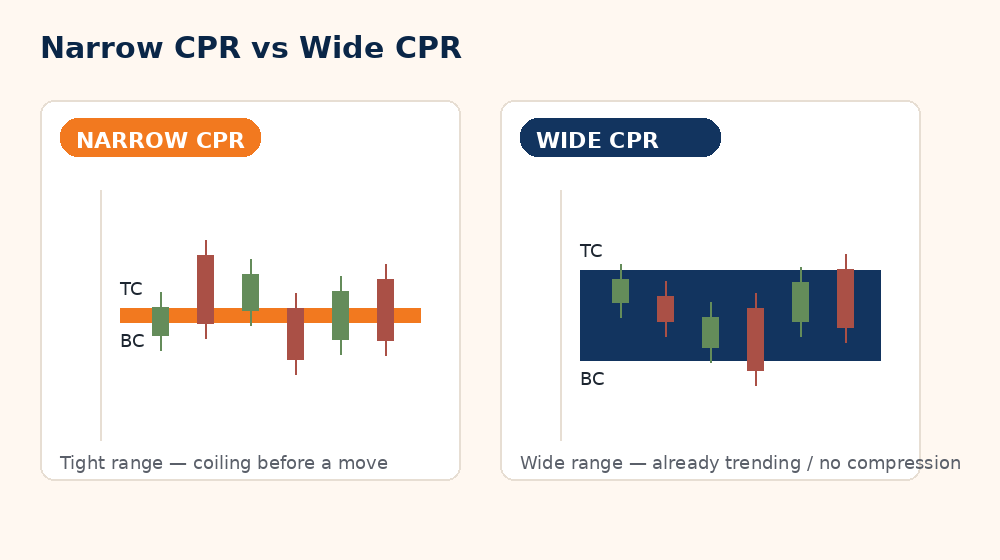
A Narrow CPR forms when a stock's Central Pivot Range compresses into a tight band, which usually means the stock is consolidating and building up energy for a bigger move. For swing traders, narrow CPR stocks are worth watching because the eventual breakout — once confirmed with a close and a retest — tends to travel further than a breakout from an already-wide, already-trending range.
A Narrow CPR (Central Pivot Range) is a pivot range where the distance between the Top Central (TC) and Bottom Central (BC) levels is unusually small relative to the stock's normal range, signalling price compression before a potential directional breakout.
Every swing trader has done this at some point — scrolled through fifty charts on a Friday evening looking for "something about to move." Most of the time, what you're actually looking for without realizing it is a narrow CPR. A stock sitting quietly in a tight range, not doing much, is often more interesting for next week's trade than one that already ran 8% today.
The CPR — Top Central (TC), Pivot, and Bottom Central (BC) — is built from the previous session's high, low, and close. When TC and BC sit close together, it means the market didn't disagree much about fair value in the prior session. That agreement doesn't last forever — a narrow CPR is a compressed spring, not a permanent state.
Here's where it gets interesting: a narrow CPR by itself is not a buy or sell signal. It's a context. It tells you a breakout, when it comes, is more likely to be a genuine expansion in range rather than one more directionless day.
On an intraday chart, a narrow CPR often just means chop for the first hour. For a swing trade, the read is different — you're not trying to catch the first five minutes of movement, you're trying to catch the start of a multi-day expansion, and compression-before-expansion is exactly the pattern that produces those.
A common pattern I see with newer swing traders is entering a narrow CPR stock the moment they spot it, without waiting for the range to actually resolve. The narrow CPR tells you where to put the stock on your watchlist. It doesn't tell you today is the day to buy it.
You don't need to calculate CPR levels by hand across the whole market every evening. A live Narrow CPR screener for next week on Chartink pulls this list for you automatically based on the previous session's data, which is far more reliable than working off a static list — CPR levels reset every single trading day, so yesterday's narrow CPR stock is not necessarily tomorrow's.
If you're working from your own NSE Bhavcopy data instead, the Narrow CPR Scanner lets you upload the CSV directly and classifies stocks by CPR Width Percentage in one pass — useful if you want to cross-check the Chartink list or build your own shortlist criteria. For a structured, step-by-step way to trade what the scanner turns up, our CPR-based courses cover the full entry-to-exit process.
Now look at what typically happens once a genuine narrow-CPR breakout starts. Price consolidates inside the tight TC–BC band for a few sessions, then closes clearly outside it on rising volume. That close alone isn't enough for me — I want to see the next session either continue in that direction or retest the broken level and hold, before treating it as confirmed.
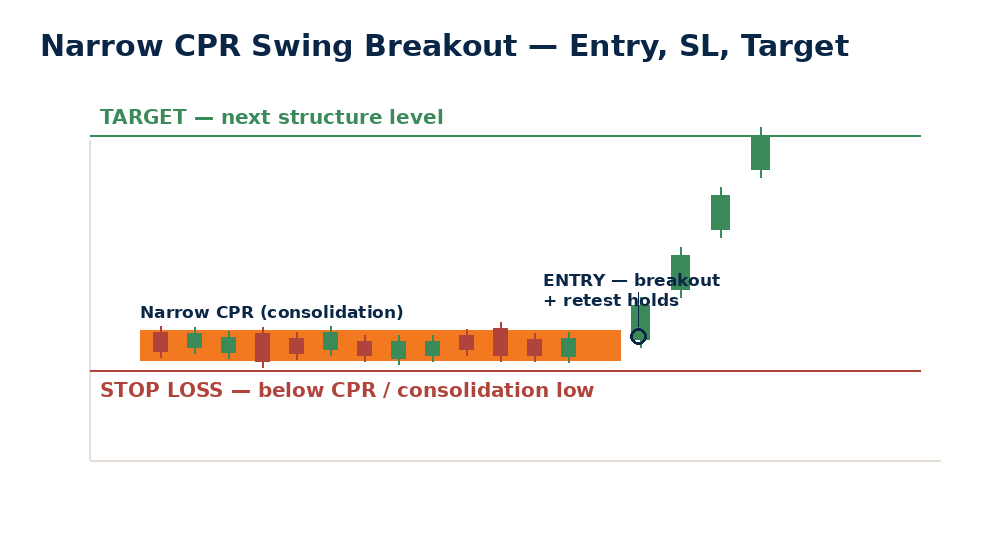
The setup looks clean on paper. The problem starts if you enter on the first breakout candle without waiting for that retest — a good number of narrow CPR breakouts fail on the first attempt and come right back inside the range.
Watch: the full Narrow CPR swing setup walked through on a live chart.
| Factor | Narrow CPR | Wide CPR |
|---|---|---|
| What it usually means | Consolidation, indecision, compression | Range already expanded, possibly mid-trend |
| Best used for | Watchlist building for a breakout swing trade | Trend-following or range-bound intraday approach |
| Breakout reliability | Higher once confirmed with retest | Lower — move may already be priced in |
| Main risk | False breakout back into the range | Chasing a move that's already extended |
| Ideal holding period | Swing (multi-day to multi-week) | Intraday to short swing |
The most common mistake is treating the narrow CPR list itself as a buy list. It's a shortlist, not a trade signal — the stock still needs to actually break out and confirm before it deserves capital.
Market mein har breakout trade nahi hota — not every breakout is a trade worth taking. The second mistake is ignoring how the broader index is behaving. A narrow CPR breakout in a stock fighting against a falling NIFTY has a lower success rate than the same setup with the index trending in the same direction. For more setups like this one, the Trading Direction blog covers CPR patterns across different market conditions.
A Narrow CPR is when the Top Central and Bottom Central pivot levels sit close together, meaning the previous session's range was tight. It typically signals consolidation and is watched by traders as a possible precursor to a bigger directional move.
Narrow CPR is used in both, but it tends to be more reliable for swing trading because the eventual breakout often plays out over several sessions rather than resolving cleanly within a single day.
The fastest way is a live screener that recalculates CPR levels daily, such as the Chartink Narrow CPR screener linked above, since CPR values change every session and a static list goes stale immediately.
No. A narrow CPR increases the odds of an eventual range expansion, but the stock can also stay range-bound for several more sessions, or the first breakout attempt can fail and pull back inside the range.
There's no fixed number of days — the trade is held until either the target (the next structural level) is hit, the stop loss is triggered, or price closes back inside the original CPR band, whichever happens first.
A standard pivot point is a single level, while CPR adds the Top Central and Bottom Central levels around it, effectively turning the pivot into a range. This range's width — narrow or wide — is what gives CPR its extra read on whether the market is compressed or already trending.
A narrow CPR is a watchlist tool, not a trigger. Pull the list, mark the levels, wait for a confirmed close outside the range with a retest that holds, then size the trade to a stop loss placed at the other side of that same range. The compression did the hard work of setting up the trade — your job is just not to jump in before it actually resolves.
Want the full framework for reading CPR levels — narrow, wide, and everything in between — before you place a trade?
Join the CPR Brahmastra WebinarStock market investments are subject to market risk. This article is for educational purposes only and does not constitute investment advice or a stock recommendation. The Narrow CPR screener and scanner referenced are tools to shortlist stocks for further analysis, not buy/sell signals. Trade only after your own due diligence and in line with SEBI guidelines.