Free Narrow CPR Stock Scanner: Daily Shortlist for Breakout Trades
Narrow CPR · Stock Scanner
There are no items in your cart
Add More
Add More
| Item Details | Price | ||
|---|---|---|---|
Most retail trader lose money not because they picked the wrong strike or entry — but because they picked the wrong side before the market told them which way it wanted to go.
exampl, in image, suppose, You buy a NIFTY Call option when you expect the index to move up before expiry, and a Put option when you expect it to move down. The decision should come from what price is actually doing — trend, CPR width, and the level being tested — not from a gut feeling about "market direction." Both options have the buyer's loss capped at the premium paid, but that doesn't mean every Call or Put purchase is a low-risk trade. remeber every buyer has a seller for that option.
A Call option increase price when market go up, to buy NIFTY at a fixed strike price before expiry — bought when you expect price to rise. A Put option this price go down when market go up, and viceversa. so, bought when you expect price to fall.
Open any options chain on a NIFTY expiry day and both Calls and Puts are moving. That's the confusing part for a new trader — you're not choosing between "up" and "down" in isolation, you're choosing based on what the chart in front of you is actually showing. Get the side wrong and even a decent entry timing won't save the trade, because theta and direction are both working against you at once.
We break down setups like this regularly on the Trading Direction blog, alongside the free Trading Direction app where you can track CPR levels on the go.
When you buy a NIFTY Call, you're paying a premium for the right to benefit if the index closes above your strike before expiry. If NIFTY is at 24,500 and you buy the 24,600 Call, you need price to move past 24,600 plus whatever premium you paid, just to be at breakeven.
Here's where it gets interesting — buying a Call is not the same as being "bullish." It's a bet that price moves up fast enough, and far enough, before time decay eats the premium. A slow, grinding up-move can still lose you money on a Call if theta outpaces the delta gain.
Buying a Put works the same way in reverse — you profit if NIFTY falls below your strike minus the premium paid before expiry. The maximum loss for a Put buyer is capped at the premium paid, no matter how far the market moves against the position.
Now look at the other side of this: a Put doesn't need a crash to work. A controlled breakdown below a CPR support with sustained follow-through is often more tradeable than a panic-driven gap-down, because gap-downs tend to get bought into within the first 15 minutes.
| Factor | Call Option (Buyer) | Put Option (Buyer) |
|---|---|---|
| Directional view | Expect NIFTY to rise | Expect NIFTY to fall |
| Max loss | Premium paid | Premium paid |
| Max profit | Theoretically unlimited | Capped (index can only fall to zero) |
| Best CPR context | Sustained breakout above CPR resistance | Sustained breakdown below CPR support |
| Works best when | Trending, expanding-range session | Trending, expanding-range session |
| Hurts you most | Range-bound chop, narrow CPR day | Range-bound chop, narrow CPR day |
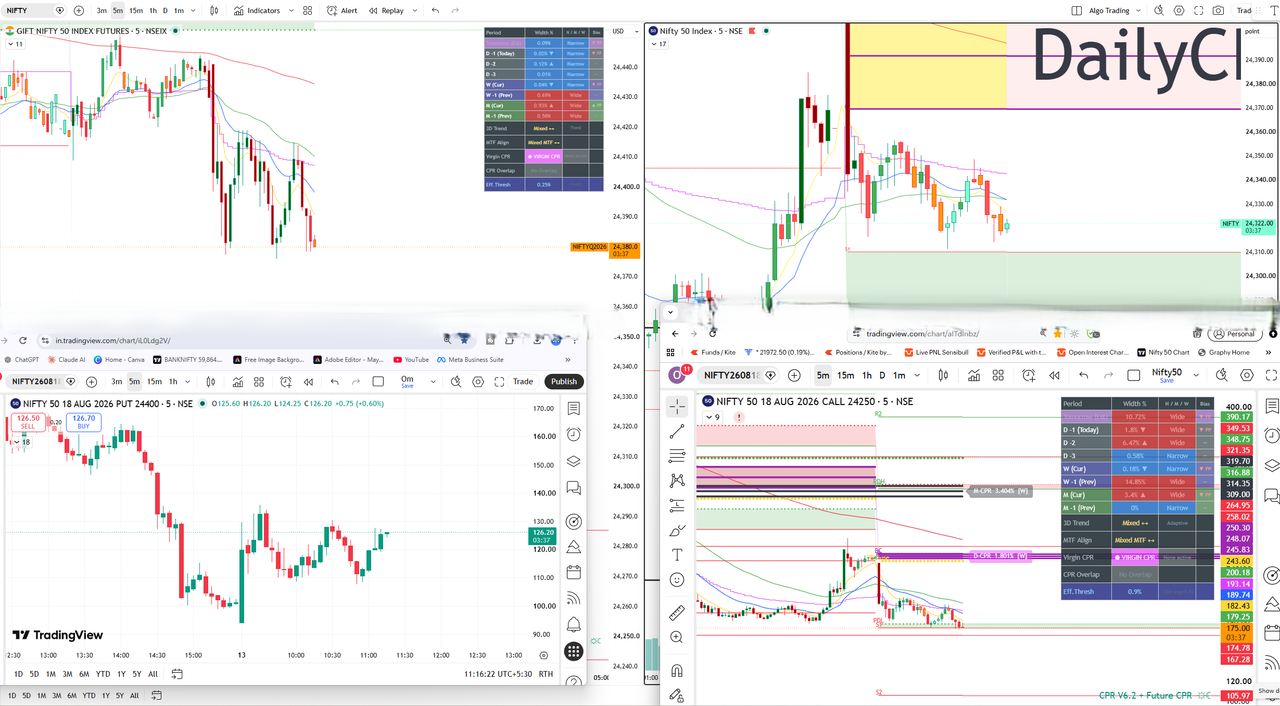
This is where most traders skip a step. They open the chart, see a red candle, and buy a Put — without checking whether that red candle is inside a narrow CPR range or breaking a genuine level. A single candle is not a direction. A sustained move away from a tested level is.
The way I look at it on the opening range: first, check where NIFTY is relative to the CPR — inside, testing the top, or testing the bottom. Second, wait for the first 15–30 minutes to show whether that level is holding or breaking. Third, only then decide Call or Put — and only if the move away from the level comes with follow-through, not a single spike.
Yahan problem direction pehchanne ki nahi, patience ki hai — the problem usually isn't misreading direction, it's not waiting for the level to actually confirm before buying the option. This CPR-first read is covered step by step in the Trading Direction book, if you want the full framework in one place.
A narrow CPR day is a warning sign either way. When the CPR width is unusually tight, the odds of a clean directional breakout go up later in the session, but the first hour is far more likely to chop both Call and Put buyers out. Don't confuse a quiet opening with "no trade today" — it often means "not yet."
The setup tells you whether a Call or a Put may be worth considering. Risk management tells you how much that idea is allowed to cost you if it's wrong.
The most common mistake isn't picking Call instead of Put or vice versa — it's entering both too early and too large. A trader sees NIFTY drop 20 points, panics into a Put at market price, and has already given up a chunk of the move to premium and slippage before the actual trend even confirms.
The second one is holding a losing option "because it might come back." A breakout is not automatically a trade, and a Call or Put that's bleeding time value after your invalidation level is hit isn't a hold — it's a hope.
If this pattern sounds familiar, it's worth reading through some trader testimonials on how others broke the same habit — the fix is almost always process, not prediction.
It can be, but most beginners lose money in the first few months because they trade without a defined stop loss and enter on impulse rather than a confirmed level. Profitability comes from consistent risk management and a repeatable process, not from picking the "right" side occasionally.
You can technically start with a few thousand rupees for a single lot depending on the premium, but having enough capital to absorb several small losses without emotional decision-making matters more than the minimum entry amount. Undercapitalized accounts tend to force oversized position sizing.
For an option buyer, the maximum loss is always capped at the premium paid, regardless of how far the market moves against the position. This is different from selling options, where the risk profile is not capped the same way.
Neither, until the range actually breaks with follow-through. A narrow CPR often precedes a strong directional move later in the day, but the first breakout attempt frequently fails, so entering on the first move without confirmation is one of the more common ways to lose to theta and whipsaws.
This usually happens when the move up is slow relative to how much time is left to expiry, so time decay (theta) offsets the gain from the index rising. It can also happen if the strike chosen was too far out-of-the-money for the size of the move.
Most CPR-based intraday decisions are made off the 5-minute or 15-minute chart, using the opening 15–30 minutes to see how price is behaving around the level, rather than reacting to every 1-minute candle.
Call vs Put isn't a coin flip and it isn't a gut call either — it's a decision that should come after price has told you something at a level that matters. Wait for the level, wait for confirmation, size the position to your stop loss, and let the setup earn the trade instead of forcing one because you have a view on "where the market should go."
Want a structured way to read CPR levels before deciding Call or Put? The CPR Brahmastra Strategy webinar walks through the exact framework used in the examples above.
Join the CPR Brahmastra WebinarOptions trading involves substantial risk and is not suitable for every investor. This article is for educational purposes only and does not constitute investment advice. Past patterns are not a guarantee of future results — trade only after understanding the risks involved, in line with SEBI guidelines.