

Free Narrow CPR Stock Scanner: Daily Shortlist for Breakout Trades
Narrow CPR · Stock Scanner
There are no items in your cart
Add More
Add More
| Item Details | Price | ||
|---|---|---|---|
Two live NIFTY accounts, the same trading day, two completely different outcomes — here's the market logic behind it, not just the result.
Neither option buying nor option selling is "better" on its own — the market condition decides the winner. On a range-bound, wide-CPR day, sellers usually profit because time decay (theta) works in their favor while price stays trapped. On a trending breakout day, buyers can win big and fast because delta moves in their favor before theta has time to hurt them. The two live NIFTY accounts below, from the same session, show exactly this.
Option buying is paying a premium for the right (not the obligation) to buy or sell NIFTY at a fixed strike — limited, defined risk, but time decay works against you. Option selling is collecting that premium upfront in exchange for taking on the obligation — time decay works for you, but risk is theoretically open-ended and margin requirements are far higher.
Every few weeks a new trader asks me the same question: "Sir, option buying better hai ya option selling?" (Is option buying better, or option selling?) The honest answer is neither — the same NIFTY session can hand a buyer a loss and a seller a profit at the exact same time, for reasons that have nothing to do with luck. Two screenshots from a single trading day make this easier to see than any theory lesson.
When you buy a NIFTY Call or Put, you pay a premium upfront. That premium is your maximum loss — nothing more can be taken from you. But that premium also melts every single day the market doesn't move in your favor, whether you're watching the screen or not.
When you sell a NIFTY Call or Put, you receive that same premium upfront, and your broker blocks a much larger margin against your account as collateral. If the option expires worthless, you keep the entire premium. If the market moves sharply against your sold strike, your loss is not capped at the premium — it can run into multiples of what you collected.
Both screenshots below are from the same session, 13th August 2026, NIFTY trading in a tight band around 24,394.
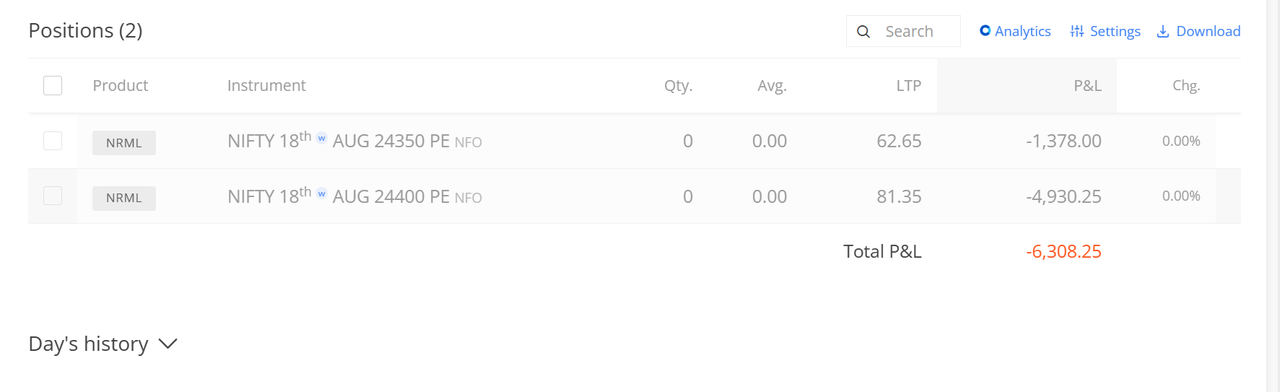
This buyer took a bearish view using weekly puts. Nothing about the trade idea was reckless — the problem is that NIFTY simply didn't fall enough, fast enough, to outrun theta. Both puts bled value daily and were closed at a loss once it was clear the drop wasn't coming through in time.
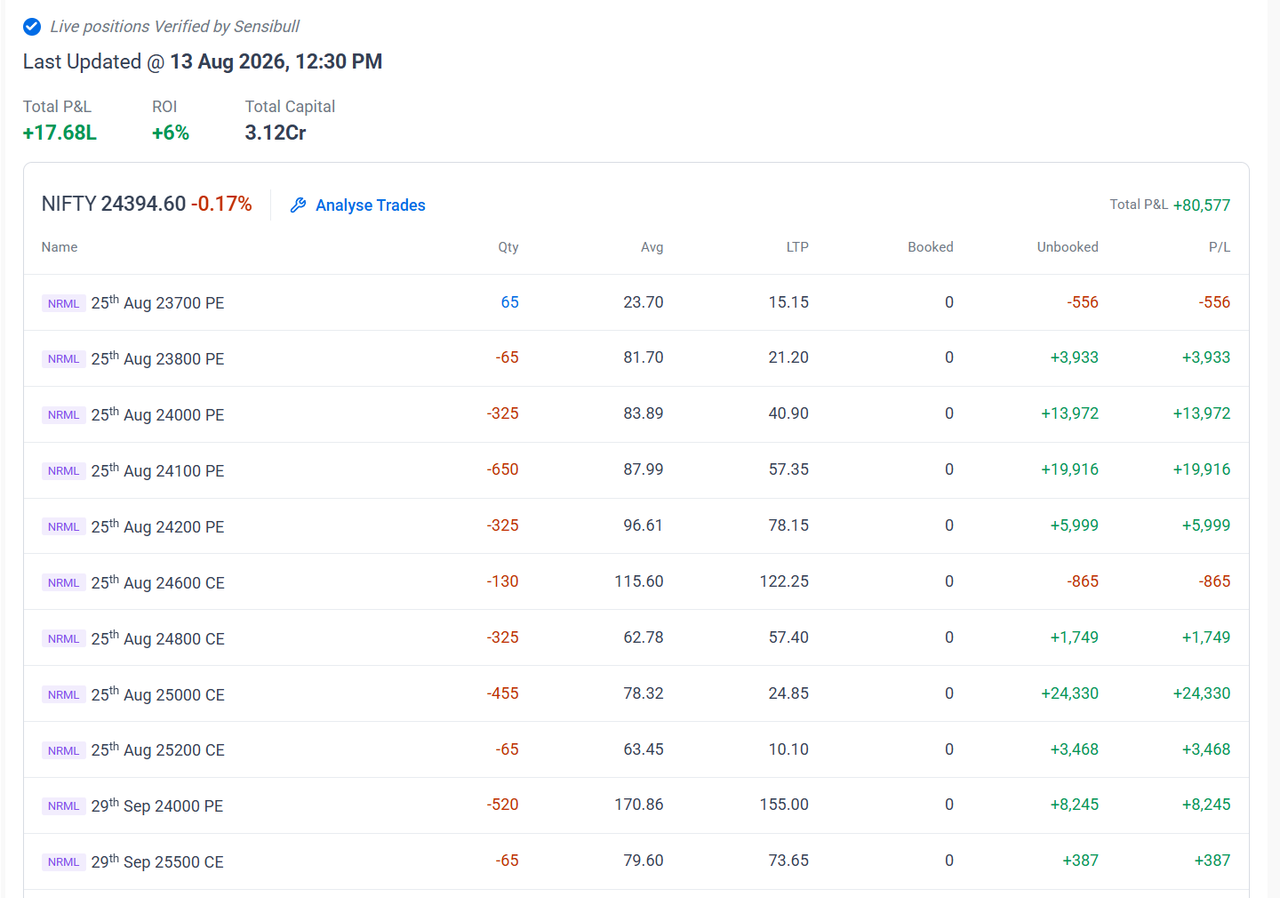
This is a much larger, diversified short-options book — puts and calls sold across a wide band of strikes (23,700 to 25,200) and across two expiries. Notice NIFTY itself barely moved that day: −0.17%. That's exactly the condition short options are built for. Most of the sold strikes show positive unbooked P&L simply because time passed and price stayed inside the range — two of the strikes (23700 PE and 24600 CE) are still in the red, which is normal; a seller's edge shows up across the whole book, not on every single strike.
| Factor | Option Buying | Option Selling |
|---|---|---|
| Capital required | Low — just the premium | High — full margin blocked by broker |
| Maximum loss | Capped at premium paid | Theoretically unlimited (uncapped for naked positions) |
| Maximum profit | Uncapped (for the long side) | Capped at premium received |
| Effect of time decay (theta) | Works against you every day | Works in your favor every day |
| Best market condition | Trending / breakout day | Range-bound / wide-CPR day |
| Monitoring needed | Lower stress once stop is set | Constant — margin calls, adjustment, hedging |
| Typical retail suitability | Easier to start with, smaller account size | Needs experience, hedges, and larger capital |
CPR (Central Pivot Range) width tells you a lot before the first candle even forms. A wide CPR usually signals indecision — the market is more likely to chop inside a range than commit to a direction. On days like that, both call and put premiums lose value simply because time is passing and price isn't running anywhere.
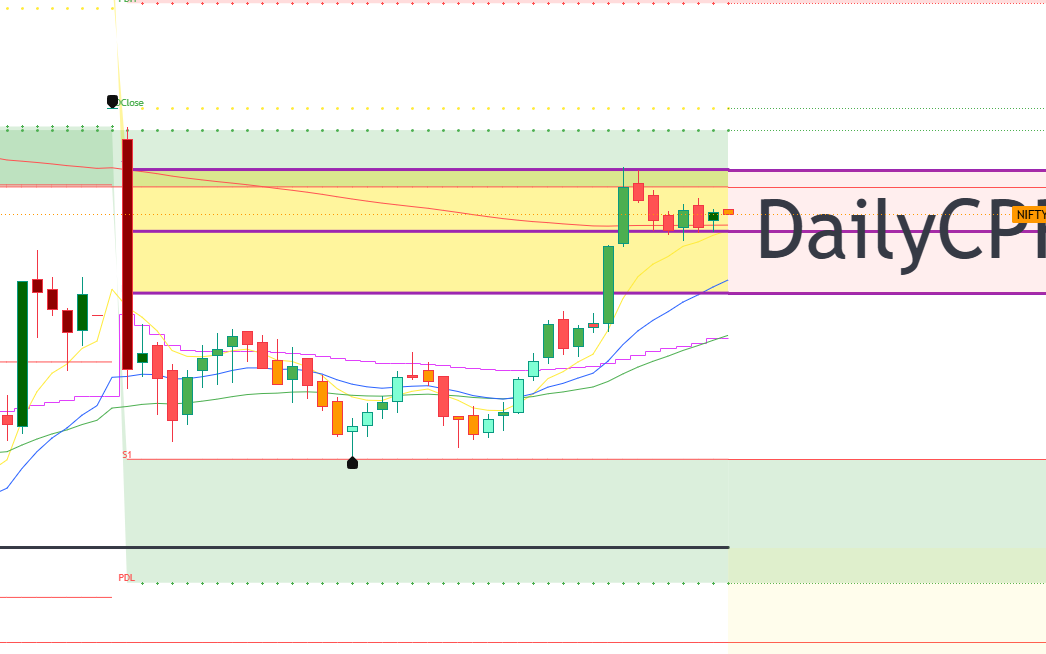
This is why the seller's book above shows strikes spread wide on both sides (23,700 puts through 25,200 calls) — the strategy isn't predicting direction, it's betting that price stays inside that wide band long enough for premium to decay.
Flip the condition and the math flips with it. On a genuine trending breakout day — a narrow CPR, a clean move away from VWAP with volume confirmation, a gap that sustains instead of fading — delta moves fast enough that the option's value can outrun theta within minutes, not days.
This is where buying earns its place. A trader who buys a call on a confirmed breakout, with a defined stop below the breakout candle, can turn a small, fixed-risk premium into a multiple of that risk if the move follows through. The setup only works because the loss is capped in advance — the buyer never needs to "manage" an unlimited downside the way a naked seller does.
Every buying-vs-selling debate eventually comes down to three Greeks and one calendar fact:
Yahan problem strategy ki nahi, execution ki hai (the problem here isn't the strategy, it's the execution) — a buyer who ignores theta and a seller who ignores vega are both making the same mistake in opposite directions: trading the Greek that doesn't matter to them and ignoring the one that does.
"Is option selling safe?" is the wrong question if you're expecting a yes-or-no answer. No options strategy — buying or selling — is inherently safe. Selling is safer for your capital survival only when it's hedged, sized correctly, and matched to a trader who can actually monitor and manage it. Unhedged, oversized selling is one of the fastest ways to blow up an account.
A common pattern I have seen while working with traders is this: it isn't buying or selling that decides the outcome, it's personality, time availability, and level of knowledge. A trader who can only check the market twice a day is safer as a buyer with a defined stop than as a seller who needs to react to an intraday spike. A trader who can sit through the session, understands hedging, and stays calm under a drawdown is often better suited to selling.
Capital changes the equation as much as personality does. A trader running option selling on ₹50,000 usually can't do it effectively — there isn't enough margin buffer to hedge, adjust, or ride out a sharp adverse move, so a single bad session can wipe out weeks of collected premium. A trader running the same style on ₹1 crore can size positions conservatively, hedge overnight risk properly, and absorb a bad day without it threatening the account. Selling isn't unsafe because of the strategy — it becomes unsafe when the capital behind it isn't enough to manage the position it's holding.
No. Option selling tends to do better on range-bound, wide-CPR days because time decay works in the seller's favor. On trending breakout days, buyers can outperform because delta moves faster than theta can erode the premium. Neither approach wins in every condition.
Because price didn't move far enough, fast enough, to beat time decay. An option can lose value every single day even while your broader market view eventually turns out correct — timing and theta matter as much as direction.
Selling requires significantly more margin than buying because your broker has to cover a potentially larger loss. Exact margin depends on the strike, lot size, and your broker's risk model — check your broker's margin calculator before sizing any sold position.
A wide CPR usually signals a higher chance of range-bound, choppy price action rather than a strong trend. It doesn't guarantee the market will stay range-bound, but it's one of the signals traders use to lean toward premium-selling strategies over directional buying.
Most beginners start with buying because the risk is capped and easier to understand. Selling is usually introduced only after a trader is comfortable with margin, hedging, and position sizing, since the downside is not capped the same way.
No. Theta decay accelerates as expiry approaches, especially in the final week. That's part of why sellers often prefer strategies closer to expiry, while buyers further from expiry need a stronger directional trigger to justify the extra time value they're paying for.
Before your next trade, check the CPR width, check whether today looks like a trapping range or a genuine trending session, and only then decide whether you're buying premium or selling it. The setup tells you when a trade may be worth considering. Risk management tells you how much that idea is allowed to cost you — whether you're the one paying the premium or the one collecting it.
If you want to see this CPR-based decision framework applied strike by strike on live charts, that's exactly what we walk through inside the CPR Brahmastra webinar.
Explore the full options courses at Trading Direction, built around the exact CPR and risk-first framework used in this article.
Explore CoursesRead more trader breakdowns like this on the Trading Direction blog, or see what other students say on the testimonials page.