Narrow CPR Scanner Free Tool — Daily & Weekly NSE Bhavcopy Scanner
Narrow CPR · Stock Scanner
Read article →
There are no items in your cart
Add More
Add More
| Item Details | Price | ||
|---|---|---|---|
Plain answers on how trading works, whether Rs 1,000 a day is realistic, the 3 trading rule, and if trading is a good way to make money.
Trading is buying and selling financial instruments such as shares, index options, commodities or currencies over a short period to profit from price changes. You place an order through a SEBI-registered broker, the exchange matches it with a counterparty, and the trade settles in your demat or margin account. Rs 1,000 a day is possible on some days, but it is not a reliable daily income, and most individual F&O traders lose money.
Definition: Trading is the active buying and selling of financial instruments to profit from short-term price movements, as opposed to investing, which holds assets for years to grow wealth.
Most people searching for what trading is really want to know one thing: can it pay my bills? This guide explains what trading is, how it works step by step, and what the numbers honestly say. As a trader, I prefer to show the math rather than promise results, so every example below is illustrative.
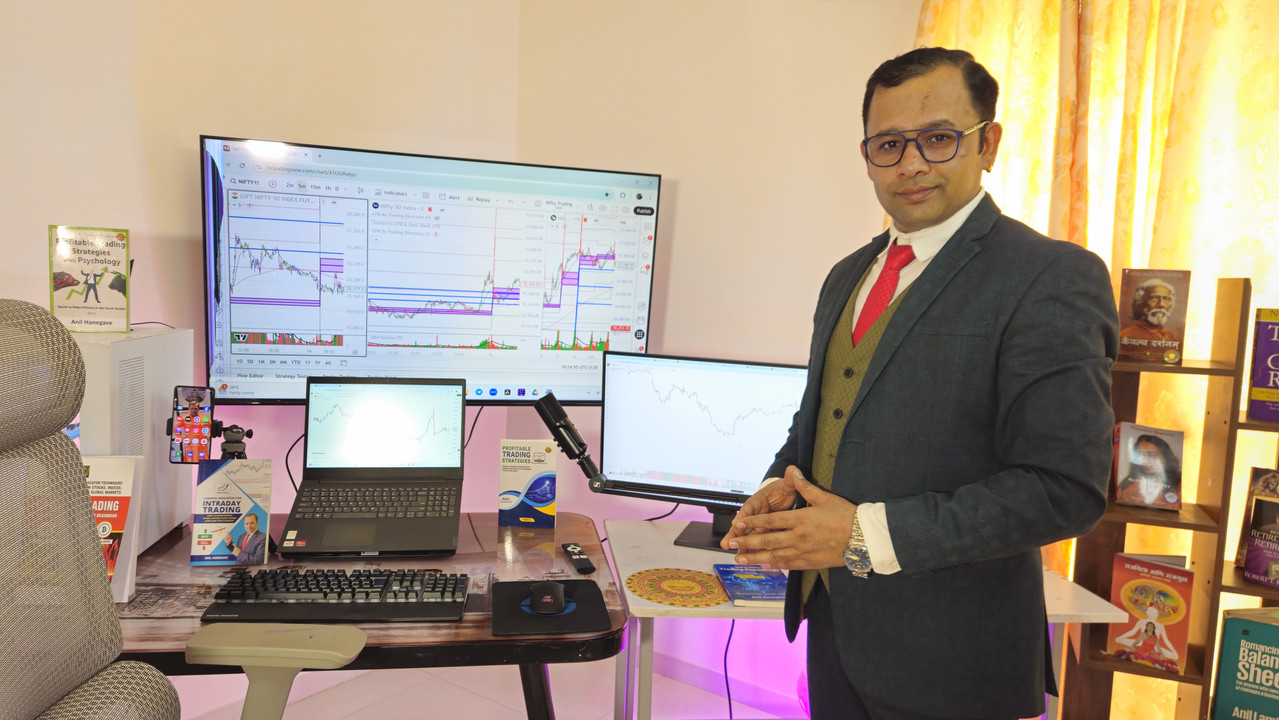
Trading works through brokers and exchanges. You open a demat and trading account with a SEBI-registered broker, place a buy or sell order, the exchange (NSE or BSE) matches it with another participant, and the trade is cleared and settled.
Equity markets in India trade from 9:15 am to 3:30 pm IST on weekdays, and equity cash settlement is T+1 (verify current timings and settlement rules on the exchange site). Your profit or loss is the difference between your buy and sell price, minus brokerage, STT, exchange charges and taxes. Prices move because buyers and sellers disagree about value, so a trader's job is to read that tug of war and act with a plan.
You buy 100 shares at Rs 500 and sell at Rs 510. Gross profit is Rs 1,000. If costs and taxes take Rs 150, your net is Rs 850. If the price had fallen to Rs 490 instead, you would have lost Rs 1,000 plus costs. Both outcomes are equally possible, which is why risk control comes before profit targets.
Trading styles differ mainly by holding time. Intraday trades close the same day, swing trades last days to weeks, and positional trades last weeks to months.
| Style | Holding time | Typical instruments | Best suited for |
|---|---|---|---|
| Intraday | Same day | Nifty, Bank Nifty, liquid stocks | Traders who can watch screens during market hours |
| Swing | 2 days to few weeks | Stocks, index futures | Working people who check charts after hours |
| Positional | Weeks to months | Stocks, commodities | Patient traders with larger capital |
| Options | Minutes to weeks | Nifty and stock options | Experienced traders who understand time decay and margins |
Personally, I like to trade options in Nifty 50, but that is a preference, not a recommendation. A beginner should first learn price action and risk control with small quantities. More on this on the Trading Direction blog.
Yes, you can make Rs 1,000 on some days, but you cannot count on it every day. Trading returns are uneven, losses are part of the process, and the capital needed to target Rs 1,000 a day safely is much larger than most beginners expect.
| Capital | Daily return needed for Rs 1,000 | Realism check |
|---|---|---|
| Rs 25,000 | 4% | Very aggressive; high chance of large drawdowns |
| Rs 50,000 | 2% | Aggressive; hard to repeat daily |
| Rs 1,00,000 | 1% | Demanding; needs strict edge and discipline |
| Rs 2,00,000 | 0.5% | More reasonable on good days, still not guaranteed |
| Rs 5,00,000 | 0.2% | Statistically easier, but risk per trade is larger in rupees |
Take a trader with a Rs 1,00,000 account who risks 1% (Rs 1,000) per trade at a 1:2 Reward to Risk Ratio. Over 10 illustrative trades with a 40% win rate: 4 wins give Rs 8,000, 6 losses cost Rs 6,000, so net is Rs 2,000 before costs. That is Rs 200 per trade on average, and the path includes losing streaks. Results arrive in clusters, not in tidy daily Rs 1,000 packets.
There is no single official "3 trading rule". The most common meaning is the 3-5-7 risk framework: risk no more than 3% of capital on one trade, keep total open risk within 5%, and use a 7% limit as a stricter circuit breaker. Different educators define the 7% slightly differently, so treat it as a starting framework, not a law.
| Part | What it limits | On Rs 1,00,000 (illustrative) |
|---|---|---|
| 3% | Maximum risk on a single trade | Rs 3,000 |
| 5% | Maximum combined risk across open trades | Rs 5,000 |
| 7% | Common version: stop trading for the month after losses reach 7% | Rs 7,000 |
I would suggest beginners stay at 1% to 2% per trade, because 3% leaves little room for a normal losing streak. The Reward to Risk Ratio then does the heavy lifting.
Trading can be a good way to make money for a small minority who treat it as a skill business with risk control. For most beginners it is a poor first source of income, because losses are common and the learning curve costs real money.
SEBI's study of individual equity derivatives traders for FY2025-26 found that 87.7% of traders in its sample incurred net losses, slightly better than the year before, and SEBI's studies have also shown losses stay persistent among continuing traders (verify the latest figures on sebi.gov.in before quoting them). Index options also dominate retail F&O activity, which adds to the risk.
| Trading | Investing |
|---|---|
| Short-term price moves | Long-term business growth |
| Needs time, screen discipline, fast decisions | Needs patience and periodic review |
| Higher costs and tax on frequent trades | Lower costs, fewer taxable events |
| Losses can compound quickly | Volatility is smoother over long periods |
If you keep a stable job or other income and trade with money you can afford to lose, trading can be a skill worth building. If you need the money for rent next month, it is not the right tool.
When NOT to trade: when you are emotionally upset, when you are using borrowed money, when the setup has no clear stop loss, or on major event days if you do not understand the volatility.
Trading means buying and selling financial instruments, like shares or options, for short-term profit instead of holding them for years.
You can start with a few thousand rupees in cash equity, but a small account makes costs and risk heavy. Many beginners practise with minimum quantity first.
It can happen on a good day, but it is not a dependable daily income. Focus on risk control and consistency, not a fixed daily rupee target.
Usually the 3-5-7 risk framework: 3% maximum risk per trade, 5% total open risk, and a 7% limit as a monthly stop. Definitions vary, so confirm what a source means.
Neither is better for everyone. Investing suits long-term wealth building, while trading demands more skill, time and risk tolerance.
Yes, trading on NSE and BSE through SEBI-registered brokers is legal. Check the latest SEBI and tax rules before you start.
Trading is a skill of managing risk, not predicting the market. Start small, define your stop loss before entry, risk 1% to 2% per trade, and judge yourself by process over months. Rs 1,000 a day is a by-product of capital and discipline, not a target to force.
Want a structured way to learn trading step by step?
Explore Trading Direction CoursesYou can also read my trading books.
Related Articles: browse more beginner guides on the Trading Direction blog.